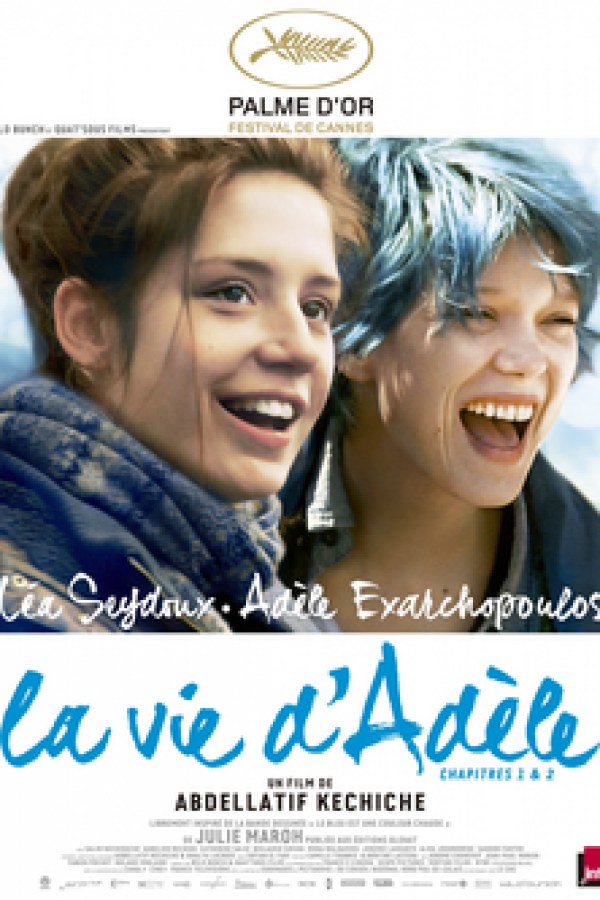
📽️ Blue Is the Warmest Color
Blue Is the Warmest Color (2013) is an intensely intimate, visually visceral, and sprawling epic that occupies a permanent, high-traffic archival slot on QueerFilmHub.com. Spanning several years, the narrative meticulously tracks the emotional, intellectual, and sexual awakening of Adèle (Adèle Exarchopoulos), a working-class French high school student who feels fundamentally disconnected from the rigid heteronormative expectations of her peers. Her world undergoes a seismic shift the moment she locks eyes on the street with Emma (Léa Seydoux), an older, fiercely confident, and bohemian art student distinguished by her vibrant blue hair.
The spark between them ignites a passionate, all-consuming romance that forces Adèle to confront her deepest desires and carve out her true identity.
Director Abdellatif Kechiche frames their evolving bond through tight, lingering, and unvarnished close-ups, capturing everything from the messy joy of their shared meals to the staggering intensity of their physical intimacy. However, as the initial euphoria of their honeymoon phase fades, the film masterfully shifts into a devastatingly grounded study of class friction, intellectual alienation, and domestic decay. Adèle’s quiet aspirations as a primary school teacher begin to clash with the elitist, high-art social circles that Emma inhabits. Ultimately, the film transforms into a monumental, heartbreaking deconstruction of a breakup, charting the painful, slow-burning erosion of an unforgettable connection and the lingering phantom ache of a first love.
💡 Did You Know? (Czy wiesz, że?) 🧠
A Historic Cannes Precedent: The film caused an absolute sensation at the 2013 Cannes Film Festival. In a historic, unprecedented move, jury president Steven Spielberg awarded the prestigious Palme d'Or collectively to director Abdellatif Kechiche and both lead actresses, Adèle Exarchopoulos and Léa Seydoux. It remains the only time in Cannes history that actresses have officially shared the festival's highest honor.
Severe Behind-the-Scenes Controversy: Despite its massive critical triumph, the film's legacy is deeply complicated by its grueling production methods. Following its release, both Seydoux and Exarchopoulos publicly condemned Kechiche’s dictatorial style, describing the shoot as "horrible" and exhausting. They revealed that the highly publicized, lengthy sex scenes took days of relentless filming with minimal direction, leading both stars to declare they would never work with the director again.
The Author's Critique: Julie Maroh, the creator of the original graphic novel, also openly distanced herself from the film's erotic sequences. Maroh criticized the director's lens as an uninspired, "heteronormative male gaze" that felt clinical, pornographic, and unrepresentative of actual lesbian intimacy.
The Color Theory of Passion: Kechiche utilizes distinct color coding throughout the film's massive runtime. Blue dominates the frame during the first half—appearing on Emma’s hair, lighting up gay bars, and coloring Adèle's wardrobe—to signify passion, discovery, and liberation. As the relationship disintegrates, blue systematically drains from the film's palette, replaced by stark, sterile, and cold tones.



Comments
No comments yet. Be the first!
Leave a comment