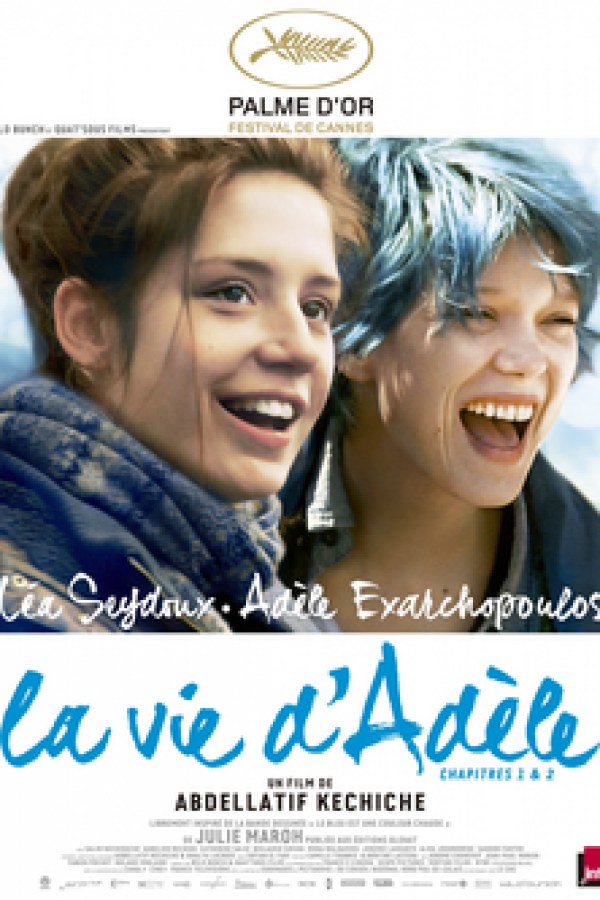
“Love is a blue flame that burns until it consumes everything.”
VIBE CHECK:
Coming-of-Age / French Realism / Intense / Melancholic
THE PLOT:
Adèle (Adèle Exarchopoulos) is a high school student whose world is quiet and predictable until she spots Emma (Léa Seydoux), a blue-haired art student, on the street. Their chance encounter ignites a decade-long odyssey of self-discovery. The film meticulously tracks Adèle’s journey from the first sparks of adolescent curiosity to the ecstatic heights of their relationship, and finally, to the agonizing, slow-motion disintegration of their bond as class differences and personal growth pull them apart.
THE QUEER & RADICAL ANGLE:
The Gaze of Desire: The film is radical in its unflinching focus on the physicality of desire. It treats Adèle’s sexual awakening not as a "problem" to be solved, but as a fundamental, life-altering force of nature.
Class & Intellectualism: It explores the radical divide between Adèle’s working-class background and Emma’s bourgeois, intellectual art world, showing how these invisible barriers can be as destructive to a queer relationship as external homophobia.
The Passage of Time: By spanning several years, it honors the reality that queer first loves are often the blueprints for the rest of our lives, regardless of whether they "last" in the traditional sense.
WHY IT KILLS:
The performances are legendary. Adèle Exarchopoulos gives one of the most nakedly emotional performances in history—you see her grow from a girl to a woman in the way she eats, sleeps, and cries. While the film has faced significant criticism regarding the male director’s "gaze" during its lengthy sex scenes, its win of the Palme d'Or at Cannes (shared uniquely between the director and the two lead actresses) remains a landmark moment for queer cinema’s visibility on the global stage.
INTENSITY SCORE: 9.4 / 10 💙🍝