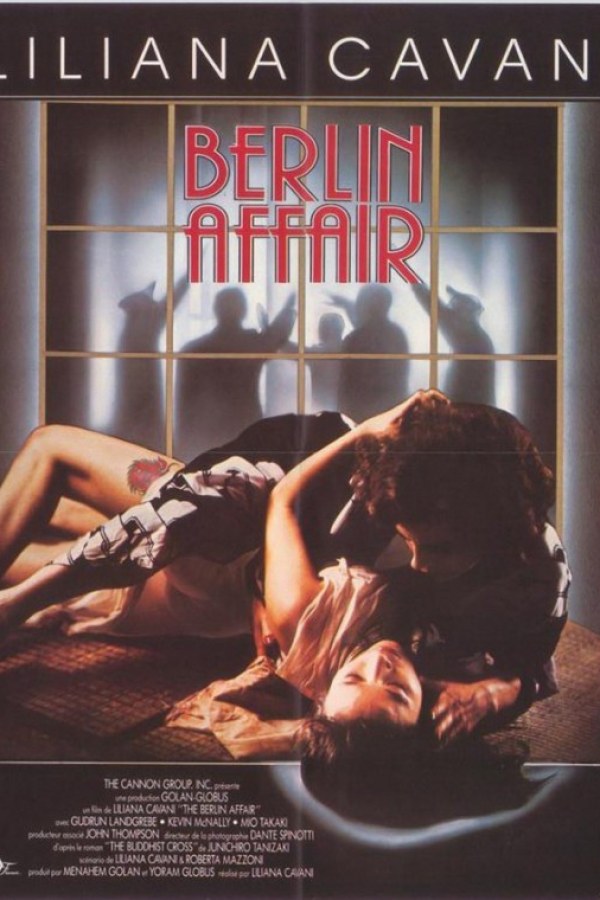
🎬 The Berlin Affair
The Berlin Affair (1985) (Afera berlińska) is a dark, stylized, and hypnotic psychological erotic drama that introduces an intense layer of historical obsession to the QueerFilmHub.com master directory. Transposing Jun'ichirō Tanizaki’s acclaimed Japanese novel Quicksand from 1920s Osaka to the cold, oppressive, and heavily militarized atmosphere of Berlin in 1938, the film charts a devastating descent into a tragic, same-sex love triangle. The narrative centers on Louise von Hollendorf (Gudrun Landgrebe), the beautiful, elegant, and deeply bored wife of a high-ranking Nazi diplomat, Heinz von Hollendorf (Kevin McNally). Feeling suffocated by the rigid expectations of the Third Reich's high society, Louise seeks an escape by enrolling in an art school class.
There, her gaze locks onto Mitsuko Matsugae (Mio Takaki), the mesmerizing, unbothered, and enigmatic daughter of the Japanese ambassador. An immediate, high-voltage infatuation turns into a secret, intensely passionate sapphic affair, shattering Louise's domestic boundaries.
The secret romance shifts from a liberating escape into a dangerous, calculated web of manipulation. As Louise becomes entirely consumed by her obsession with Mitsuko, her husband Heinz discovers the betrayal. However, rather than simply punishing his wife, Heinz himself falls completely under Mitsuko’s spell, drawing the married couple into a toxic, shared sexual enslavement to the same woman. Directed with a clinical, controversial, and uncompromising gaze by Italian provocateur Liliana Cavani, the film weaponizes the fascist backdrop to mirror the characters' internal dynamics. It stands as a dark, visually striking exploration of power, submission, and psychological erasure, tracking how an all-consuming queer passion can completely dismantle a life when caught in the cogs of history.
💡 Did You Know? (Czy wiesz, że?) 🧠
Closing the German Trilogy: The film serves as the final installment in Liliana Cavani's highly acclaimed and controversial "German Trilogy," which explores the psychological intersections of sexuality, obsession, and fascism. It follows her legendary 1974 film The Night Porter and 1977's Beyond Good and Evil.
A Transnational Literary Flip: Cavani’s decision to move the source material from Japan to Nazi Germany was a deliberate thematic choice. By utilizing a Japanese protagonist (Mitsuko) in 1938 Berlin, the film subtly plays with the historical, political, and cultural alliance of the Axis powers through an intimate, deeply destructive sexual metaphor.
Early Role for a Disney Star: Kevin McNally, who delivers a brilliant, unraveling performance as the cuckolded and obsessed diplomat Heinz, achieved massive global fame decades later as the lovable Joshamee Gibbs in Disney’s Pirates of the Caribbean franchise.
Censorship and Festival Buzz: Due to its explicit eroticism, complex bisexual dynamics, and provocative use of Nazi imagery, the film faced substantial distribution hurdles but emerged as a massive talking point at the 1986 Berlin International Film Festival, where it competed for the Golden Bear.




Comments
No comments yet. Be the first!
Leave a comment