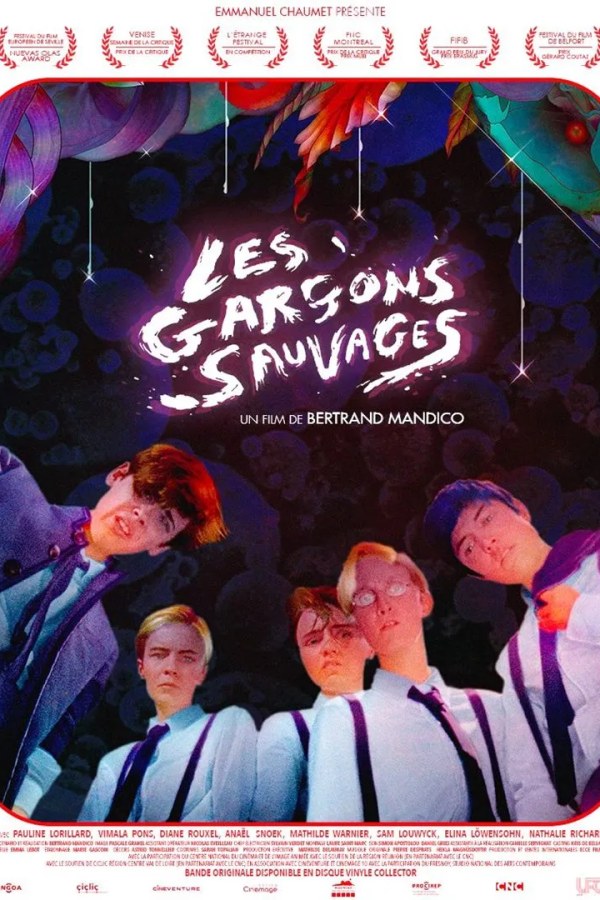
When Bertrand Mandico debuted his feature film Les Garçons Sauvages (The Wild Boys) in 2017, French independent cinema gained an uncompromising, brilliant visionary. Mandico crafted a work that is entirely hybrid—suspended between an erotic dream, a maritime adventure in the spirit of Jules Verne, and a bold queer manifesto. It is a film that you don’t just watch; you absorb it with all your senses, surrendering to its hallucinatory, trance-like logic.
The plot is set up simply, almost archetypally. Early 20th century, Reunion Island. Five adolescent boys from wealthy, bourgeois families commit a horrific crime against their literature teacher. As a punishment and an attempt at rehabilitation, their families hand them over to an authoritarian, brutal Captain, who takes them on a voyage aboard his archaic ship. The goal is singular: to break their rebellious nature. However, when the crew reaches the shores of a mysterious, tropical island with a lush, phallic, and pulsating flora, the established order of gender, power, and desire undergoes complete disintegration.
Mandico’s most vital and genius directorial stroke lies in the casting. All five growing, aggressive boys are played by adult women (including the phenomenal Vimala Pons, Pauline Lorillard, and Diane Rouxel). This choice is no cheap provocation—it is the artistic foundation of the film. Watching toxic masculinity, violence, and brutality staged through female bodies forces the audience to constantly re-evaluate what they are witnessing. Mandico dismantles gender identity, exposing it as a costume, a performance, and a fluid matter. On the mysterious island, where the characters feed on the juices of strange plants, their mental transformation begins to manifest physically. The lines between masculinity and femininity blur as naturally as the boundaries between waking life and dreams.
Visually, Les Garçons Sauvages is an absolute masterpiece of camp and poetic surrealism. Mandico rejects realism in favor of a tactile, studio-bound artificiality that recalls the early cinema of Jean Cocteau, Kenneth Anger, and the style of Guy Maddin. The shifts between rich black-and-white and heavily saturated, neon colors, rear-projections, triple exposures, and the omnipresence of fluids (from ocean waves to thick plant sap) create a dense, deeply sensual atmosphere.
Les Garçons Sauvages is not a film for everyone—it can provoke or frustrate with its non-linear narrative, heavy symbolism, and radical form. Yet, it stands indisputably as one of the most fascinating and original stories of transformation, liberation, and identity fluidity that contemporary European cinema has produced. Mandico proves that true wildness lies not in destruction, but in the courage to shed socially imposed roles.
Rating: 8.5/10