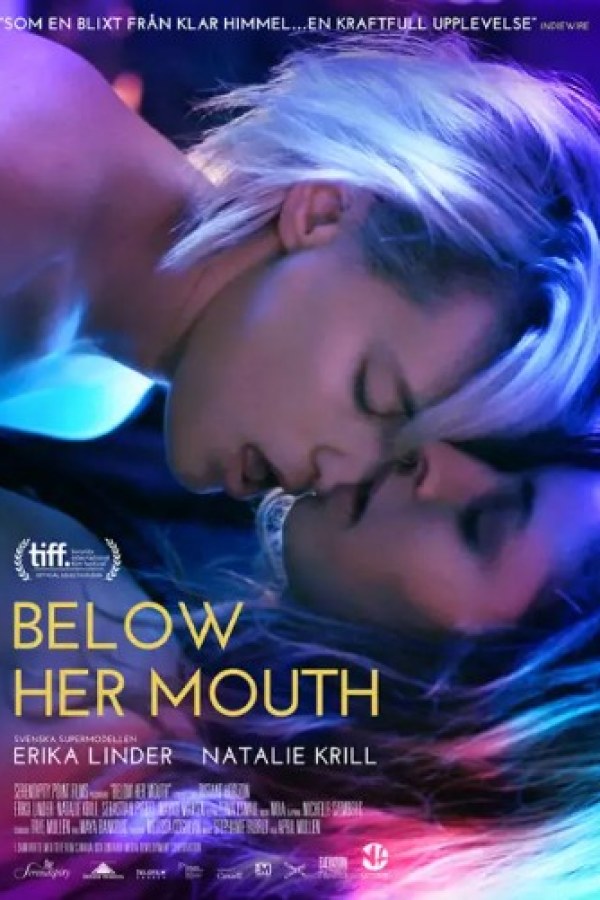
👑 MOVIE REVIEW: Below Her Mouth (2016)
Crafted by an all-female production crew, April Mullen’s Below Her Mouth was explicitly designed as an answer to the male gaze in erotic cinema. Directed by Mullen and scripted by Stephanie Fabrizi, the film sets out to deliver an uninhibited portrait of female desire—one where the camera accompanies genuine intimacy without shame or voyeurism.
A Weekend That Changes Everything
Jasmine (Natalie Krill) is a successful fashion editor whose life appears seamlessly ordered. She lives in an elegant Toronto home and is preparing to marry her long-term fiancé, Rile. Everything shifts abruptly when her fiancé leaves town on a business trip and Dallas (Erika Linder)—a rugged, confident roofer fresh off a painful breakup—crosses her path.
What begins as a chance encounter in a nightclub rapidly escalates into an intense, passionate affair. Intended as a single fleeting moment, the weekend forces Jasmine to confront her suppressed identity and question the authenticity of the life she built.
The Female Gaze & Onscreen Chemistry
The film’s greatest asset lies in its visual approach to intimacy. Thanks to cinematographer Maya Bankovic and the magnetic screen debut of Swedish androgynous model Erika Linder, the onscreen connection vibrates with raw tension.
Reframing Erotic Aesthetics: Desire and nudity are portrayed without prudish reservation, yet entirely free from objectification. The camera focuses on touch, nuance, and emotional resonance.
The Linder & Krill Dynamic: Erika Linder’s brooding presence offers a striking contrast to Natalie Krill’s more reserved, internally transforming character.
Where Drama Yields to Eroticism
Despite its commendable production ethos and dedication to authentic queer representation, Below Her Mouth suffers from narrative thinness. The plot follows predictable beats typical of infidelity and sudden self-discovery tropes, while the dialogue occasionally feels secondary to setting up the next intimate sequence.
QueerFilmHub Verdict
Below Her Mouth stands as a significant title regarding representation and the structural mechanics of queer filmmaking—proving how crucial it is to place the camera in women's hands when telling stories of female longing. While narratively formulaic, it remains a bold, visually striking chronicle of instant, overwhelming passion.
Rating: 6.5/10