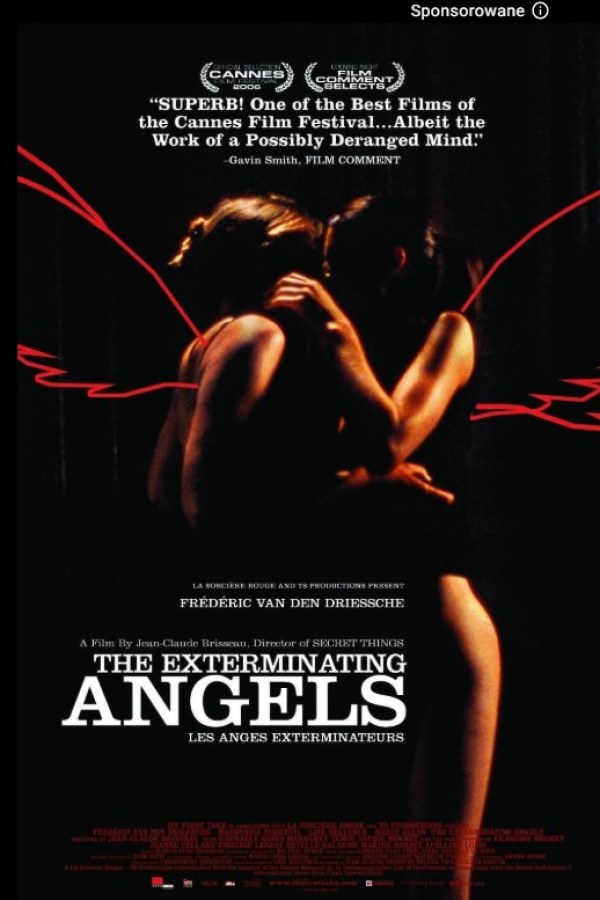
Jean-Claude Brisseau has long balanced on the razor's edge between auteur cinema and refined provocation, but The Exterminating Angels represents the most radical, self-reflexive work of his career. The French director rewrites the classic motif of the demiurge obsessed with his own creation, delivering a film that is audacious, claustrophobic, and deeply unsettling.
A Director Trapped in His Own Matrix
The premise initially flirts with the aesthetics of an erotic psychological thriller: François, a filmmaker (serving as a transparent alter ego for Brisseau himself), is preparing a new project and conducts casting sessions where he encourages young women to push past social and moral boundaries in front of the camera. His obsession lies in capturing raw, unsimulated female pleasure and the taboos that govern it.
However, Brisseau instantly strips the narrative of any cheap, mainstream sensationalism. Instead, he transforms the film set and a Parisian apartment into a tense psychological laboratory. The true subject of the film is not the sexual transgression itself, but the ruthless deconstruction of artistic authority. François operates under the illusion of control, viewing himself as a cold, clinical observer dissecting a societal matrix. Yet, with every audition, as the raw, untamed fantasies of his actresses surface, that illusion of power shatters completely.
Stripping the Masks of Bourgeois Morality
The film's greatest strength lies in its portrait of the friction between intellect and instinct. The protagonist’s living room transforms into an emotional battlefield where polite cultural masks melt away under the heat of repressed desire. The women participating in his experiment cease to be mere subjects of study; they become a disruptive force that exposes the hypocrisy, vulnerability, and inherent fears of the creator himself.
Visually, the film pulses with a dark, almost dreamlike magnetism. Long, static takes establish an atmosphere of confinement, while the austere minimalism of the staging heightens the sense that we are witnessing a forbidden ritual. Brisseau refuses to moralize or offer the audience a safe alibi—he forces the viewer into the uncomfortable position of a voyeur, raising haunting questions about the ethics of artistic exploitation.
The Verdict
The Exterminating Angels is highly niche, challenging, and deliberately provocative cinema that pushes the boundaries of conventional taste. It stands as a fascinating, if painful, essay on creative narcissism, the steep price of radical liberation, and how the pursuit of absolute truth in art often ends in complete psychological bankruptcy. For viewers seeking an uncompromising autopsy of human desire, it remains essential viewing.
Rating: 7.5/10