At a Glance: A visionary force behind the Greek Weird Wave, Athina Rachel Tsangari crafts cinema where body language replaces exposition, human behavior is studied like an animal documentary, and tender intimacy emerges from deadpan absurdity.
🏛️ The Catalyst of the Greek Weird Wave
Before Athina Rachel Tsangari became one of international arthouse cinema's most distinctive voices, she was a vital catalyst behind the scene itself. As a producer and director, Tsangari—alongside collaborators like Yorgos Lanthimos—helped define the Greek Weird Wave, a movement born out of Greece's late-2000s economic crisis that challenged traditional narrative structures with surrealism, social alienation, and deadpan satire.
Her production company, Haos Film, served as the incubator for landmark titles (including Lanthimos’s Dogtooth), but it is Tsangari’s own directorial vision that gave the movement its most emotionally resonant and anthropologically curious soul.
🎨 Key Themes & Signature Style
1. The Body as a Canvas (Kinetic & Physical Cinema)
In Tsangari’s films, dialogue often takes a back seat to physical movement. Characters communicate through synchronized dances, animalistic mimics, awkward kisses, and ritualistic games. Her cinema reminds us that human beings are, above all, biological creatures trying to navigate social constructs.
2. Anthropological Detachment Meets Tenderness
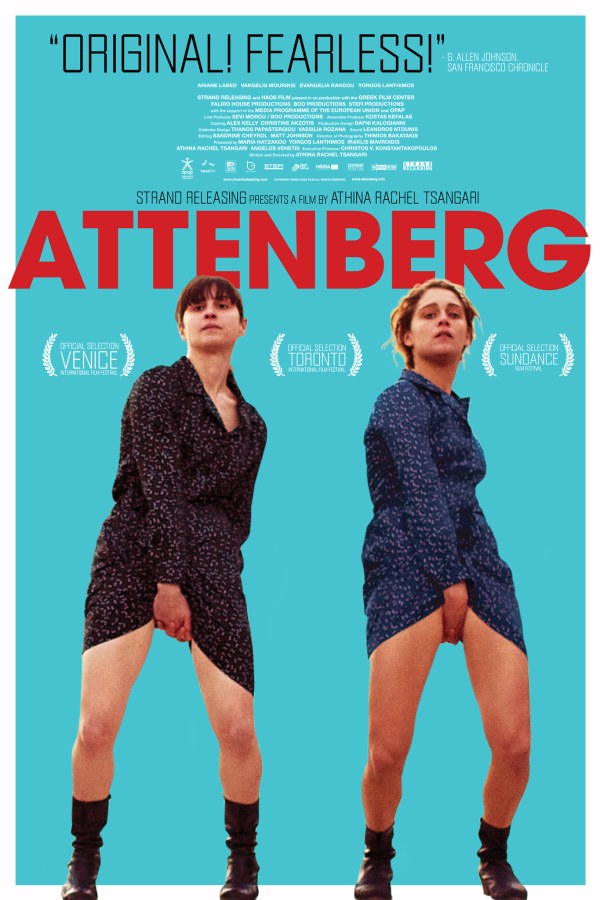
Tsangari looks at humanity through the lens of a nature documentary—much like her protagonist in Attenberg watching David Attenborough. Yet, despite this observational distance, her work never lacks empathy. Beneath the clinical, minimalist aesthetic lies a deep fascination with grief, loneliness, and the genuine warmth of human affection.
3. Deconstructing Masculinity & Female Intimacy
Whether exploring the unspoken, curious intimacy between two young women (Attenberg) or dissecting the fragile, competitive egos of men stranded on a yacht (Chevalier), Tsangari excels at peeling back the layers of gender roles to expose the absurdities underneath.
🎬 Essential Filmography
The Slow Business of Going (2000) — Her debut feature; a low-budget, globe-trotting sci-fi experiment exploring memory and digital nomadism.
Attenberg (2010) — Her breakthrough masterpiece. A quirky, poignant coming-of-age story starring Ariane Labed and Yorgos Lanthimos that won the Volpi Cup at the Venice Film Festival.
Chevalier (2015) — A brilliant, razor-sharp satire of male vanity, where six men on a luxury boat compete in a series of absurd tests to determine who is "the best at everything."
Harvest (2024) — A striking historical adaptation exploring community, land, and displacement in a pre-industrial village.
💡 Why Her Work Matters to Queer & Arthouse Audiences
Tsangari’s cinema embodies a queer sensibility that goes beyond conventional representation. She disrupts traditional cinematic gaze, rejects normative relationship structures, and celebrates the strange, fluid ways people connect when conventional rules no longer apply.
"We are animals pretending to be civilized." — Tsangari’s filmography remains an essential study of human nature: eccentric, visually arresting, and fiercely original.